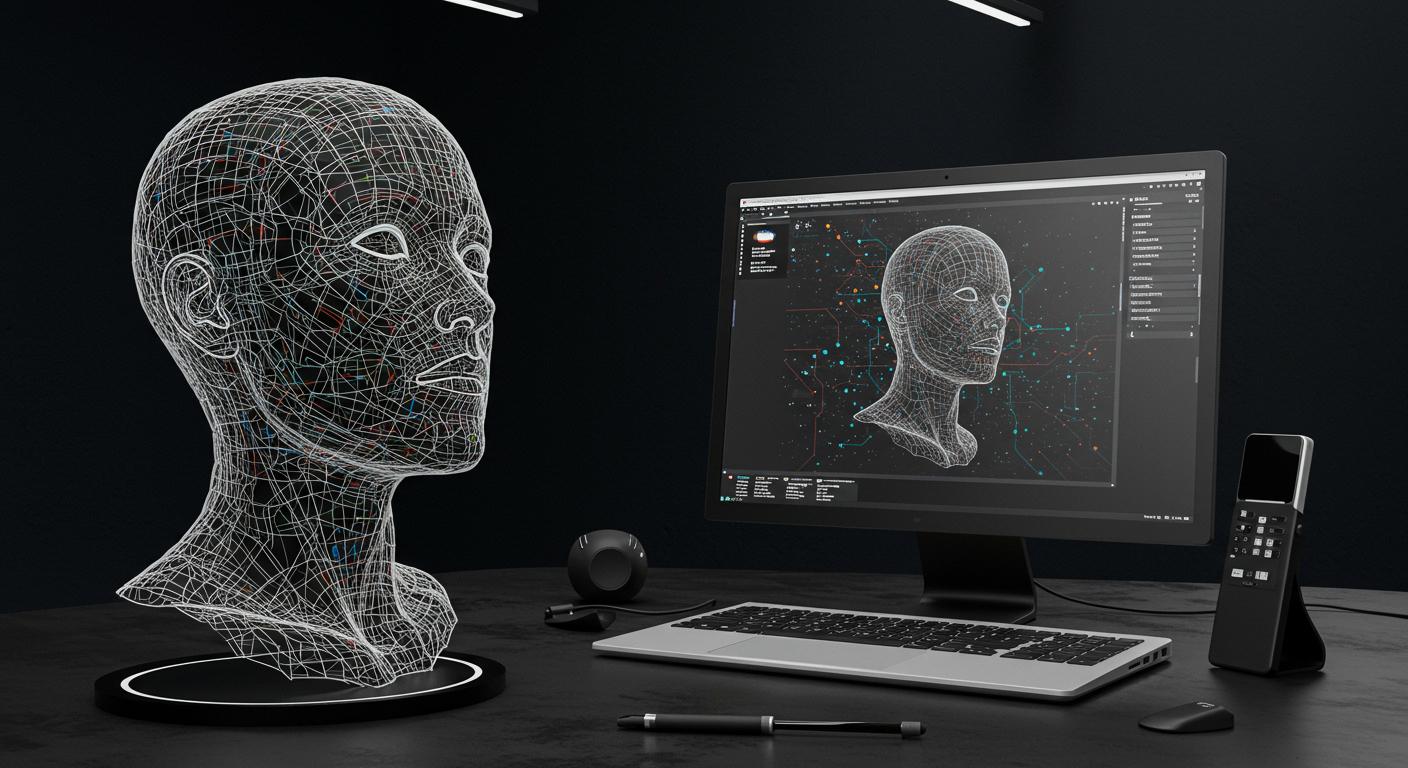
Hyper3D just turned 3D AI from a one-shot generation trick into a real creative tool. Rodin Gen-2 Edit lets you talk to your 3D models — literally — and reshape them with natural language. This is the missing piece the entire 3D AI pipeline has been waiting for.
The Story: From Generation to Conversation
Every 3D AI tool until now has followed the same pattern: you feed in a prompt or image, wait, and get a model out. If the result is 90% right but the left arm is wrong, you start over. Rodin Gen-2 Edit breaks this cycle entirely.
Built by Hyper3D (formerly Deemos), Rodin Gen-2 Edit is the world’s first true 3D GenAI editing platform. The core innovation: you can upload any 3D model — your own assets, models from other tools, whatever — and modify them using natural language or voice commands. Select an area by dragging a box, describe what you want changed, and the AI handles the rest. Need to turn a beach buggy into an armed motorcycle? Just say so.

Under the Hood: 10 Billion Parameters and BANG
Rodin Gen-2 runs on a 10-billion parameter architecture called BANG (Bilateral Algorithmic Neural Generation). The BANG paper was recognized among the Top 10 Technical Papers at SIGGRAPH 2025, and for good reason — it solves one of the biggest headaches in AI 3D: the fact that most models output a single fused mesh blob that no artist can actually work with.
BANG uses recursive part-based generation, intelligently dividing objects into coherent components. A generated character comes out with separate head, torso, arms, legs — like a real artist would build it. This means clean topology, proper UV layouts, and meshes that are actually riggable. The 4X improvement in geometric mesh quality over Gen-1 isn’t just a marketing number — the quad-based topology genuinely holds up for animation and game pipelines.
The Killer Features
Partial Redo. Generated a sword but the hilt looks off? Select just the hilt, describe what you want, and regenerate only that part. The rest stays untouched. This alone puts Rodin in a different league from every competitor.
Smart Low-poly + Normal Baking. Upload any model, convert it to artist-style low-poly wireframes, then bake all the high-poly detail into normal maps. One community member (@WJ_T_BOY) demonstrated a workflow where you can take any external model through this pipeline and get game-ready assets in minutes.
T/A-Pose Control. Toggle this on and generated characters automatically come out in standard T-Pose or A-Pose — a godsend for anyone who’s ever tried to rig an AI-generated character that came out in some random yoga position.
Voice-Driven Editing. Hyper3D bills this as the first AI product where you can edit 3D models with your voice. It’s not just a gimmick — for rapid iteration during concepting, being able to say “make the helmet bigger, add spikes on the shoulders” while viewing the model is genuinely faster than typing.

Why You Should Care
Until now, AI 3D generation has been a parlor trick with a critical flaw: zero iteration control. You generate, you hope, you start over. That’s not a creative tool — that’s a slot machine. Rodin Gen-2 Edit is the first platform that treats 3D AI like an actual production workflow: generate, review, refine, ship.
The implications are massive for game development (rapid asset prototyping), VFX (previs and stand-in modeling), e-commerce (product visualization from a single photo), and even 3D printing. And with the API available on Replicate, fal.ai, and WaveSpeed, this isn’t locked behind a single platform — you can integrate it into your own pipeline.
Try It / Follow Them
- Platform: hyper3d.ai — free to generate, pay to download
- API: developer.hyper3d.ai | Replicate | fal.ai
- Twitter/X: @DeemosTech
- Free trial: Use code awnRodinEdit at hyper3d.ai for 14 days of Creator Plan
- Export formats: FBX, GLB, OBJ
IK3D Lab Take
This is the inflection point we’ve been waiting for. Generation was step one — editing is where 3D AI becomes a real tool instead of a toy. The BANG architecture’s part-based approach is technically brilliant, and the fact that you can bring your OWN models into the editing pipeline (not just Rodin-generated ones) is what makes this genuinely production-viable. The catch? Complex multi-part assemblies still need cleanup, and you need clean input images to get clean output. But as a first draft machine that you can actually iterate on? Nothing else comes close right now.